
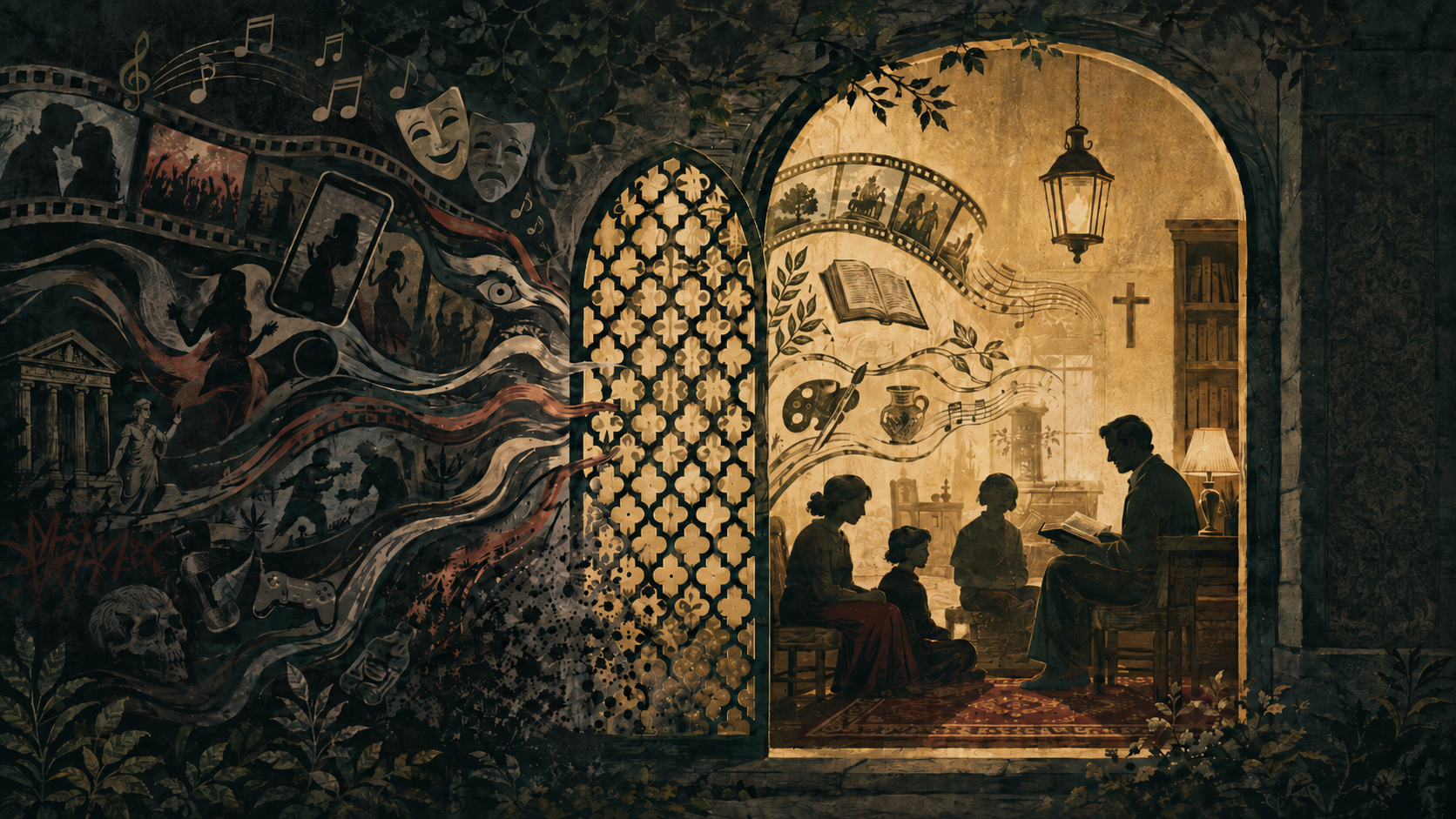
Every Christian must learn to ask better questions about entertainment. It is not enough to ask whether a film contains profanity, whether a song is explicit, or whether a series includes sexual content. Those questions matter, but they do not reach the deepest issue.
The governing question is not merely, “What does this entertainment show me?” but, “What is it training me to love, excuse, admire, laugh at, or desire?”
Stories, songs, and images are never entirely neutral. They shape our moral instincts, often without our noticing. Christian discernment therefore requires us to consider four things: the clear lines Scripture tells us not to cross, the subtler sins and worldviews entertainment teaches us to admire, the cumulative effect of repeated exposure, and the practical action we should take before and during what we watch or hear. These concerns apply to every believer, while those who lead—or are preparing to lead—a household carry an added responsibility.
How Is Sin Being Presented?
The Bible itself contains accounts of murder, adultery, betrayal, drunkenness, revenge, and sexual immorality. The mere presence of sin in a story does not make the story sinful. The more important questions are: How is the sin being presented? What am I being encouraged to feel about it? Is it exposed as evil or celebrated as desirable? Is the story warning me, or inviting me to participate through my imagination?
Scripture portrays terrible wickedness, but it does so truthfully. It does not invite us to savour evil. It exposes sin, displays its consequences, and directs us toward righteousness. Much modern entertainment does the opposite: it makes sin beautiful and holiness ridiculous. Christians are not called to withdraw from every serious portrayal of a fallen world, but to discern the moral vision beneath the portrayal.
Clear Lines That Should Not Be Crossed
Some forms of entertainment should not require lengthy debate. Pornography, erotic nudity, sexually explicit material, and scenes deliberately designed to provoke lust have no place in the Christian life.
Job said, “I have made a covenant with my eyes; how then could I gaze at a virgin?” (). Our Lord likewise warned that “everyone who looks at a woman with lustful intent has already committed adultery with her in his heart” ().
Nudity on screen is not the same as the portrayal of death. When an actor is “killed,” no one has actually died; the violence is simulated. But when nakedness is deliberately displayed, the viewer is genuinely seeing what does not belong to him. He is being invited to become a spectator of what should remain private.
We should not consume as entertainment what God forbids us to desire. Nor should we choose portrayals that invite us to approve, celebrate, or take sinful pleasure in what God condemns. The same seriousness should apply to entertainment built around blasphemy, the mockery of Christ, sadistic cruelty, or a deliberate fascination with darkness and the occult. There may be difficult questions around the edges, but some things should simply be turned off.
The “Respectable Sins” We Learn to Admire
The subtler danger is found in what might be called respectable sins. These are sins that no longer shock us because the culture has made them familiar, humorous, attractive, or admirable:
Revenge is presented as justice.
Pride is presented as confidence.
Greed is presented as ambition.
Sexual immorality is presented as romance.
Rebellion is presented as courage.
Dishonesty is presented as cleverness.
Drunkenness is presented as harmless fun.
Contempt is presented as humour.
Self-centredness is presented as authenticity.
A film need not contain explicit nudity or constant profanity to shape us wrongly. Its central moral vision may be corrupt. We can slowly begin to sympathise with adultery, excuse dishonesty, admire revenge, laugh at drunkenness, or treat marriage and sexual purity as outdated burdens.
Music can work in the same way, perhaps even more subtly. Lyrics are rehearsed, memorised, and emotionally reinforced. We should ask what vision of sex, money, anger, manhood, womanhood, success, or freedom we are repeatedly singing into our hearts. A catchy melody does not make a corrupt message harmless.
Entertainment also carries broader worldviews. Progressive ideology may portray rebellion against God’s created order as liberation and obedience as repression. Consumerism teaches that happiness is found in possessions. Radical individualism presents personal fulfilment as the highest good. Careerism turns success into a saviour. Cynicism makes detachment appear wise. The pressure is seldom to renounce Christ in a single moment. It is enough that we stop resisting, stop grieving, and eventually stop noticing.
When Blasphemy Becomes Background Noise
Early in our marriage, my wife, Claudia, and I watched the television series Community. The humour was sharp, the episodes were short, and it fitted easily into our evening routine.
Over time, however, I noticed that many punchlines landed on a blasphemous point or criticism of the Christian message. More concerning was that we eventually began repeating some of those jokes ourselves. We were holding out the gospel publicly while privately making light of heavenly realities.
confronted me: “Let no corrupting talk come out of your mouths, but only such as is good for building up.” I decided that we would no longer watch the series. It was initially disruptive because it suited our routine, but we have never returned to it.
That experience taught me that the question is not merely whether I can watch something without immediately committing an obvious sin. I must also ask what it is doing to my affections, speech, imagination, and reverence for God.
Desensitisation is gradual. At first, something shocks us. Then we tolerate it. Later, we laugh at it. Eventually, we repeat it ourselves or defend our right to consume it. If we become unfazed by what once troubled us, that may not be evidence of maturity. It may be evidence that our conscience is being slowly seared.
Seeing What the Culture Has Normalised
The story of the Christian monk Telemachus offers a striking illustration. According to the fifth-century historian Theodoret, Telemachus travelled from the East to Rome and entered an arena during a gladiatorial contest. His protest embodied the distinctly Christian conviction that every human being bears the image of God and therefore must never be reduced to an object of amusement.
Telemachus stepped between the combatants and tried to stop them from killing one another. The crowd, accustomed to bloodshed as entertainment, stoned him to death. Theodoret records that when Emperor Honorius heard what had happened, he honoured Telemachus as a martyr and put an end to the gladiatorial combats.
Telemachus saw as horrifying what Rome had learned to enjoy. That is what a renewed Christian conscience does. The fact that a culture has normalised something does not make it harmless. There may likewise be forms of entertainment our society considers ordinary that Christians should recognise, resist, and refuse to consume.
Prepare to Act, Not Merely to Analyse
It is wise to investigate entertainment before consuming it. Reviews can identify content and themes in advance. The Gospel Coalition’s film and television resources offer thoughtful Christian reflection on the theological and cultural meaning of films. Plugged In is particularly useful for detailed advance information about sexual content, violence, language, spiritual themes, alcohol, and other concerns across movies, television, music, games, and books. Neither resource can make the decision for us, but both can help us make it with greater knowledge.
No review will reveal everything, and objectionable content may appear unexpectedly. When that happens, the Christian should be prepared to pause, skip the scene, turn the programme off, or walk out of the cinema. Money already spent, time already invested, and curiosity about the ending are not sufficient reasons to continue. Turning something off is not an overreaction when continuing would violate a conscience trained by Scripture.
If children have already seen or heard something inappropriate, do not pretend it did not happen. Explain why it was wrong, distinguish the world’s message from God’s truth, and let them see that repentance and decisive action matter more than saving face.
A Conscience Trained by Scripture
The conscience is not automatically reliable. It must be continually informed and corrected by Scripture. Something may not trouble us simply because we have encountered it for years. Many of our instincts were formed before we began consciously submitting every area of life to Christ.
calls us to be transformed by the renewal of our minds so that we may discern what is good, acceptable, and perfect. The world has catechised us for many years. We should not be surprised when our tastes, reactions, and pleasures require retraining.
Leading the Home with Wisdom
These principles apply to every Christian, but husbands, fathers, and men preparing for family leadership bear a particular responsibility. A man is not deciding only what he personally can tolerate. He is helping to shape the moral imagination of his household. His wife and children will learn from what he permits, what he laughs at, what he criticises, and what he is willing to turn off.
This leadership should not be harsh, fearful, or suspicious. The aim is not to create a culturally empty home filled with prohibitions. It is to cultivate a home in which Christ is treasured, holiness is beautiful, and the family learns to enjoy what is good.
Christian households should seek entertainment that enlarges gratitude, awakens wonder, strengthens courage, permits laughter without shame, and helps them recognise beauty, sacrifice, faithfulness, and truth. A man should develop convictions with his wife, not merely impose rules upon her. Children will often need stronger boundaries than adults because what an adult may critically assess, a child may simply absorb and imitate.
Before Watching—and While Watching—Ask
Does this invite me to lust or place before me nakedness that does not belong to me?
Does it mock Christ, Scripture, the church, or sacred things?
Does it make sin appear attractive, admirable, humorous, or consequence-free?
Who am I being taught to admire, and why?
Does this weaken my hatred of sin or strengthen desires I must put to death?
Would I want children in my care to imitate what is being celebrated?
Afterward, am I more inclined toward gratitude, purity, courage, truth, and love—or toward lust, cynicism, anger, revenge, and discontentment?
Am I defending this because it is genuinely good, or because I do not want to give it up?
directs our minds toward whatever is true, honourable, just, pure, lovely, commendable, excellent, and worthy of praise. This does not mean every story must avoid sorrow, conflict, or evil. It means the overall direction of our minds should be toward what is worthy of Christian affection.
More Than “Am I Allowed?”
The Christian life is not governed merely by the question, “Is this technically forbidden?” Paul writes, “‘All things are lawful,’ but not all things are helpful. ‘All things are lawful,’ but not all things build up” ().
Something need not be explicitly forbidden by name before it becomes unwise. We must guard against self-righteousness and avoid binding other consciences where Scripture has not bound them. Yet we must not use Christian liberty as an excuse for spiritual carelessness. Liberty is not freedom to see how close we can come to sin. It is freedom from sin so that we may serve and enjoy God.
The goal is not to become experts in avoiding entertainment. The goal is to become increasingly captivated by Christ, so that what dishonours Him gradually loses its appeal. Guard your heart. Lead those entrusted to you gently and deliberately. No entertainment is so valuable that it is worth dulling your love for Christ.