
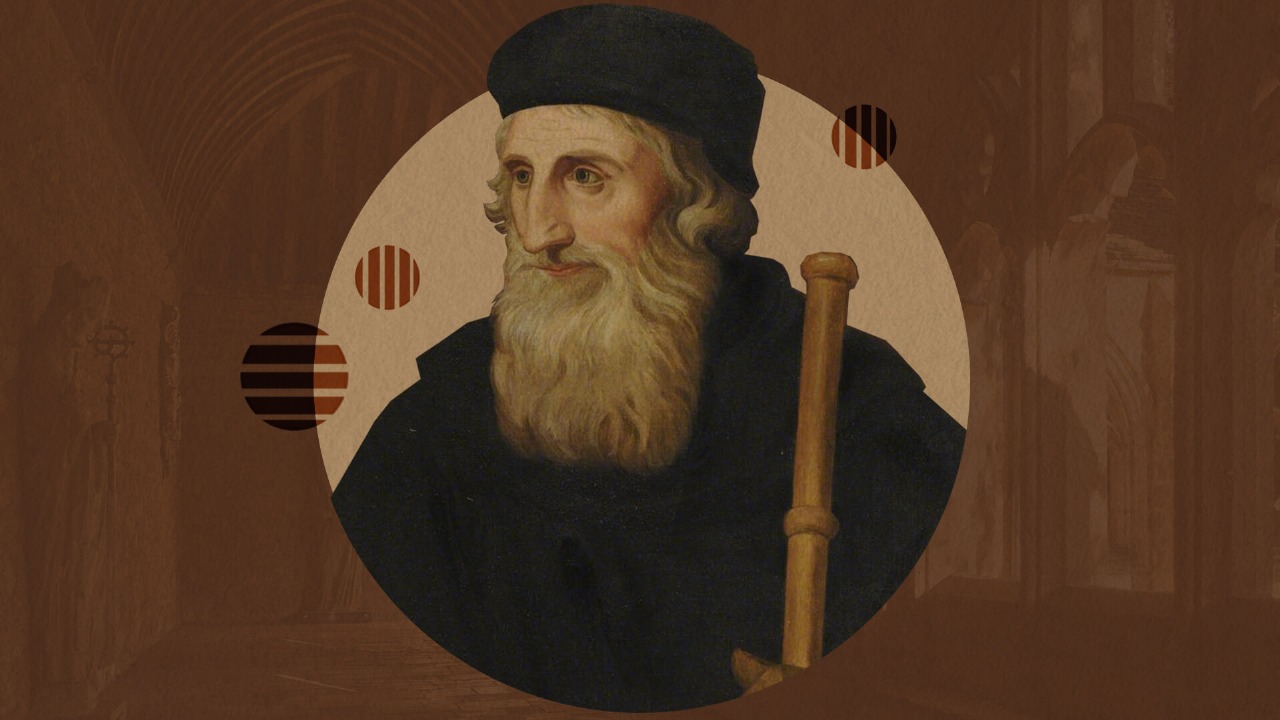
“Trust wholly in Christ; rely altogether on His sufferings; beware of seeking to be justified in any other way than by His righteousness.”1
—Traditionally attributed to John Wycliffe
The Protestant Reformation was not born in a moment. Long before Martin Luther published his Ninety-Five Theses in 1517, God was preparing the ground through earlier generations of preachers, scholars, translators, and reformers. Among the most important was John Wycliffe, the fourteenth-century English theologian often remembered as the “Morning Star of the Reformation.”
Wycliffe was not a sixteenth-century Protestant living ahead of his time, and not all his theological conclusions should be accepted without qualification. Nevertheless, he perceived with remarkable clarity that the church must remain under the authority of Scripture, that ordinary Christians should hear God’s Word in a language they understand, and that no pope, priest, or institution can stand above Jesus Christ.
These convictions remain urgently relevant to the church in Africa today.
The World of Wycliffe
John Wycliffe was born in England around 1330 and spent much of his adult life studying and teaching at Oxford University. He became one of the most distinguished philosophers and theologians of his generation.2
The medieval church into which Wycliffe was born was not entirely devoid of faithful Christians, careful theologians, or movements of spiritual renewal. Yet it was also burdened by grave institutional problems. Clerical wealth, political ambition, moral corruption, and struggles for power frequently obscured the church’s spiritual calling. The papacy had become deeply entangled in European politics, while many ordinary believers depended almost entirely upon priests for their knowledge of Christianity.
The Western Schism, beginning in 1378, exposed this institutional instability dramatically. Rival popes claimed supreme authority over the church, each condemning the other. Such turmoil raised an unavoidable question: if competing church leaders could claim divine authority while contradicting one another, where could Christians find a final and trustworthy standard?
Wycliffe’s answer was increasingly clear: the church must be governed by the Word of God.3
His concern went deeper than calling corrupt priests to behave more honourably. He questioned whether any office, however ancient or prestigious, could claim authority apart from faithfulness to Christ. A pope did not become infallible merely by occupying the papal throne. A priest did not become righteous merely through ordination. Every Christian teacher and institution remained accountable to God and therefore subject to Holy Scripture.
Scripture Above Human Authority
“All Scripture is breathed out by God and profitable for teaching, for reproof, for correction, and for training in righteousness.”
Wycliffe became convinced that Scripture possessed an authority no pope, council, university, or tradition could equal. Because the Bible is God’s Word, it provides the supreme standard by which the teaching and conduct of the church must be tested.
This did not mean that Wycliffe rejected every creed, council, theologian, or Christian tradition. He was deeply influenced by Augustine and other earlier teachers. His point was that every human authority remains capable of error. Scripture alone stands above correction because its ultimate author is God.
That distinction remains vital for Africa.
A Bible displayed on a pulpit does not necessarily govern a church. Scripture may be quoted while its meaning is ignored. Verses may be repeated while sermons revolve around the preacher’s dreams, private revelations, personal ambitions, or promises of wealth and success.
The decisive question is not whether a church owns or quotes the Bible, but whether Scripture exercises final authority over its doctrine, worship, leadership, and life.
No pastor is too anointed to be corrected by Scripture. No prophet is too powerful to be tested by Scripture. No tradition is too ancient to be judged by Scripture. No cultural practice is too deeply rooted to be reformed by Scripture.
The church belongs to Christ, and every servant of Christ must stand beneath His Word.
The Word in the Language of the People
“So faith comes from hearing, and hearing through the word of Christ.”
Wycliffe’s conviction concerning biblical authority naturally produced a concern for biblical access. If Scripture governs every Christian, then Christians must be able to hear and understand it.
The Bible available to most educated clergy in Western Europe was the Latin Vulgate. Earlier portions of Scripture had appeared in forms of English, but the movement associated with Wycliffe produced the first complete Bible in Middle English. This translation was made from the Latin Vulgate rather than directly from the original Hebrew and Greek, and the work was almost certainly collaborative. Scholars continue to debate how much Wycliffe translated personally, but the project arose from his influence and was completed by members of his circle.4
It is therefore more accurate to speak of the Wycliffite Bible than to imagine Wycliffe translating the entire work alone.
This qualification does not diminish his importance. It reminds us that Bible translation is ordinarily a shared labour. Scholars, translators, pastors, language specialists, reviewers, and local churches work together so that people may hear the mighty works of God in their own languages.
This remains an urgent task in Africa. Although Bibles are widely available, access is not universal, and ownership is not the same as understanding. Some Christians worship in languages they only partially understand. Others own Bibles but have never been taught how to read a passage in its context. In many churches, congregations hear disconnected verses used to support the preacher’s message rather than the message of Scripture being carefully explained.
The African church therefore needs more than Bible distribution. It needs faithful translation, literacy, expository preaching, theological education, and Christian resources written in the languages people use in their homes.
A closed Bible cannot instruct the church. An untranslated Bible cannot address the heart clearly. A misinterpreted Bible can become an instrument of manipulation.
Wycliffe’s legacy reminds us that God’s people must not merely possess the Word; they must hear it, understand it, believe it, and obey it.
Preaching Beyond the Academy
Wycliffe did not want theology confined to Oxford lecture halls. His movement became associated with itinerant preachers—sometimes called “poor priests”—who travelled through England preaching to ordinary people. His teaching continued through the Lollards, who carried many of his reforming convictions beyond the university and into homes, villages, and local communities.5
This aspect of his legacy speaks powerfully to Africa.
Theological education is essential, but theology must not remain trapped within seminaries, conferences, and academic publications. Truth must travel from the classroom into the pulpit, from the pulpit into the home, and from the home into the ordinary lives of Christians.
Africa does not merely need a few celebrated conference speakers. It needs thousands of faithful local pastors who can open the Scriptures week after week and explain what God has spoken. It needs teachers willing to labour in villages, cities, schools, prisons, homes, and small congregations that may never provide fame or financial reward.
Reformation ordinarily spreads through seemingly ordinary faithfulness: a pastor carefully explaining a biblical text, a mother teaching Scripture to her children, a translator searching for the clearest expression, an elder correcting error, or a Christian sharing the gospel with a neighbour.
The Word of God does not require spectacle to possess power.
Christ, Not the Religious Middleman
“For there is one God, and there is one mediator between God and men, the man Christ Jesus.”
Wycliffe’s theology should not simply be equated with the more precise formulations developed during the later Reformation. He remained a medieval theologian, and some of his positions were unusual or undeveloped. Nevertheless, his ministry increasingly directed people away from confidence in ecclesiastical status and toward Jesus Christ.
This emphasis remains deeply relevant wherever religious leaders present themselves as indispensable channels of divine favour.
In parts of Africa, the pastor or prophet is treated as an “anointed mediator” whose blessing must be purchased, whose commands cannot be questioned, and whose spiritual status places him beyond accountability. People may be told that healing, employment, marriage, fertility, deliverance, or prosperity depends upon sowing money into the life of the “man of God.”
The gospel announces something far better: Christ alone brings sinners to God.
No payment can improve His sacrifice. No prophet can complete His mediation. No ritual can supplement His righteousness. No priest can reopen what His blood has settled.
Faithful ministers do not stand between Christ and His people. They stand beneath Christ’s authority and point His people towards Him.
The Cost of Reform
Wycliffe’s convictions brought him into increasing conflict with the church authorities of his day. Some of his teachings were condemned, and his followers were later persecuted. Yet he continued writing and preaching until his death in 1384.
His influence spread beyond England, reaching reformers such as Jan Hus in Bohemia. The relationship between Wycliffe, Hus, and the later Protestant Reformation was real, though neither simple nor direct. Wycliffe did not personally begin the Reformation, but he helped raise questions that later generations could no longer avoid.6
Decades after his death, the Council of Constance condemned his writings. In 1428 his remains were exhumed, burned, and his ashes cast into the River Swift.7
A later writer transformed this grim event into a memorable image: the Swift carried his ashes into the Avon, the Avon into the Severn, the Severn into the sea, and the sea into the ocean—symbolising the spread of his teaching throughout the world.8
The image is poetic, but its message is fitting. Church authorities could burn Wycliffe’s remains, but they could not silence the question he had placed before the church:
What has God said?
A Call to Reformation in Africa
The African church does not need to reproduce every feature of Wycliffe’s theology. It does, however, need the convictions his life represents.
We need Scripture above personality. Every pastor, prophet, bishop, founder, and denomination must be tested by God’s Word.
We need biblical understanding rather than mere possession. Christians must learn to read Scripture in context and see how the whole Bible finds its fulfilment in Christ.
We need the Word in the languages of the people. Translation and local-language theological education belong to the church’s missionary task.
We need ordinary, courageous preachers. Reformation requires pastors willing to lose popularity, money, or influence rather than distort Scripture.
Above all, we need Christ rather than religious commerce. Where spiritual blessings are sold and vulnerable people exploited, the sufficiency of Christ must be proclaimed again.
Wycliffe was not a flawless reformer, but his life still directs us towards a necessary truth: the church must always stand under the authority of the Word of God.
True reformation in Africa will not come through the pursuit of novelty, celebrity, or spectacle. It will come as the Spirit of God works through the Word of God to conform the people of God to the image of the Son of God.
“The grass withers, the flower fades, but the word of our God will stand forever.”
May that enduring Word be translated, preached, read, believed, and obeyed throughout Africa. May Christ’s voice be heard above every rival voice. And may the church on this continent continually be reformed according to the Word of God, for the glory of Christ alone.
Soli Deo Gloria.
Notes:
John Wycliffe, Writings of the Reverend and Learned John Wickliff, D.D. (London: Religious Tract Society, 1847), 41.
Alessandro D. Conti, “John Wyclif,” in The Stanford Encyclopedia of Philosophy, substantive revision May 6, 2025, sec. 1.1.
Conti, “John Wyclif,” sec. 5.1.
Mary Dove, The First English Bible: The Text and Context of the Wycliffite Versions (Cambridge: Cambridge University Press, 2007), 246–47.
Anne Hudson, The Premature Reformation: Wycliffite Texts and Lollard History (Oxford: Clarendon Press, 1988), especially chs. 1–2.
Michael Wilks, “‘Reformatio Regni’: Wyclif and Hus as Leaders of Religious Protest Movements,” Studies in Church History 9 (1972): 109–30.
Conti, “John Wyclif,” sec. 1.1.
Thomas Fuller, The Church-History of Britain: From the Birth of Jesus Christ until the Year 1648 (London: John Williams, 1655), book 4, fifteenth century, sec. 2.