
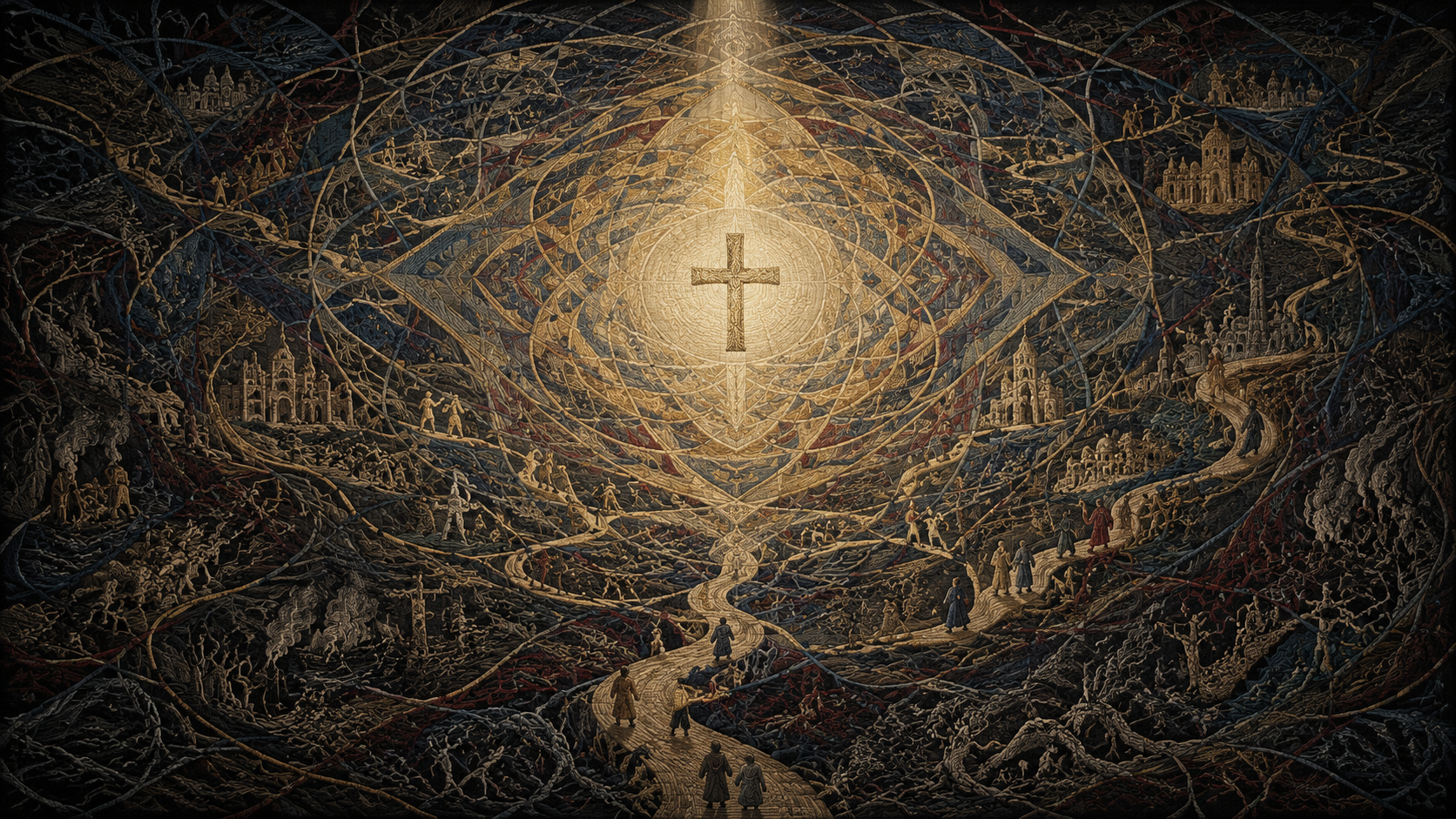
“The Lord has made everything for its purpose, even the wicked for the day of trouble.”
—
Introduction
How has God ordained the fabric of reality? What does it mean for God truly to be God? Is He a distant observer, passively watching history unfold, or the sovereign Lord who “upholds the universe by the word of His power” ()?
Scripture leaves no doubt: the living God is intimately involved in every detail of His creation. Every atom, heartbeat, kingdom, and human decision exists within His sovereign decree. To be God is not merely to possess power, but to exercise perfect, purposeful, wise, and holy authority over all things.
God’s sovereignty refers to His absolute rule over creation. His decree is His eternal purpose by which He has ordained everything that comes to pass. His providence is the execution of that decree in time, as He preserves, governs, and directs all creatures and events towards His appointed ends.
The relationship between divine sovereignty and human action is often described as compatibilism. Compatibilism teaches that God sovereignly ordains all that comes to pass, including voluntary human decisions, while human beings remain genuine moral agents who act willingly and are accountable for what they do.
God’s sovereignty and human responsibility are not rival explanations of an event. God acts as the sovereign Creator and primary cause, while creatures act as real secondary causes according to their own intentions and natures. God’s purpose is ultimate and decisive, yet human choices remain genuinely our own.
God is not merely one agent alongside others. He sustains our existence, orders our circumstances, directs our steps, and governs the outcome of our actions. Yet He ordinarily accomplishes His purposes through genuine creaturely agency rather than by eliminating it.
Compatibilism affirms that even in human rebellion, God remains sovereign; and under His sovereign rule, human actions remain meaningful and morally accountable.
Freedom, Agency, and Human Nature
Agency is the capacity to think, desire, choose, and act. Human beings are moral agents because our thoughts, intentions, and actions are truly ours, and God rightly holds us accountable for them.
Compatibilism does not define freedom as independence from God or the ability to act outside His decree. No creature possesses that kind of autonomy. We depend upon God for our existence, faculties, circumstances, and every breath.
Rather, we act voluntarily when we act according to our own desires and intentions without being externally compelled against our wills. Our choices are morally significant because they reveal what we love and what kind of people we are.
Yet the human will is not morally neutral. Because of the Fall, our nature has been corrupted by sin (; ). Left to ourselves, we willingly choose what is contrary to God, not because we are forced to sin, but because our fallen hearts love darkness rather than light ().
Our bondage to sin does not make our actions involuntary. It means that our voluntary actions arise from a corrupt nature. We remain responsible because we do what we want, even though what we want is disordered.
This must be distinguished from spiritual freedom. In regeneration, God renews the heart and liberates us from slavery to sin so that we begin to desire, love, and obey Him. As Jesus said, “If the Son sets you free, you will be free indeed” ().
Responsible agency does not require independence from God. True spiritual freedom is found not in autonomy, but in deliverance from sin and joyful obedience to Him.
Scriptural Foundations
Few passages capture compatibilism more clearly than .
Joseph’s brothers, driven by hatred and jealousy, sold him into slavery. Their intentions were undeniably wicked. Yet years later, after God had raised Joseph to authority in Egypt and used him to preserve many lives, Joseph said:
“As for you, you meant evil against me, but God meant it for good, to bring it about that many people should be kept alive.”
Joseph does not say that his brothers meant evil while God merely permitted their actions and later brought good from them. The same event contained two real intentions.
The brothers meant Joseph’s suffering for evil. God meant it for good.
Their purpose was sinful; God’s purpose was righteous. Their intention was destructive; God’s was preservative and redemptive. God’s design did not excuse their evil, nor did their evil frustrate His design.
The same event was fully governed by God and freely committed by responsible human beings.
A similar truth appears in the story of Pharaoh. Scripture records both divine and human agency:
“The Lord hardened the heart of Pharaoh.”
—
And:
“Pharaoh hardened his heart and would not listen.”
—
Both statements are true. Pharaoh acted willingly according to his pride, cruelty, and self-interest. At the same time, God sovereignly ordained and judicially governed Pharaoh’s rebellion for the display of His glory.
Paul explains:
“For this very purpose I have raised you up, that I might show my power in you.”
—
God’s hardening was neither arbitrary nor morally corrupt. He did not introduce wickedness into an innocent heart. Pharaoh was already rebellious.
Divine hardening was a righteous act of judgement. God gave Pharaoh over to his existing corruption, withheld restraining mercy, confirmed him in rebellion, and ordered the circumstances through which Pharaoh freely displayed what was already in his heart.
presents the same pattern when God “gave them up” to the desires they had embraced (). God’s judgement did not make innocent people sinful. It handed sinners over to the sin they already loved.
God’s sovereignty and human choice are therefore not competing forces:
“The king’s heart is a stream of water in the hand of the Lord; He turns it wherever He will.”
—
And yet:
“The heart of man plans his way, but the Lord establishes his steps.”
—
Human beings plan, desire, and act. God establishes, directs, and governs. The creature’s intention remains real, but God’s purpose remains ultimate.
Compatibilism in Redemptive History
This pattern appears throughout Scripture.
In Job, Satan is the immediate malicious agent of suffering. He destroys Job’s possessions, kills his children, and afflicts his body. Yet he acts only within the limits God establishes:
“Behold, all that he has is in your hand. Only against him do not stretch out your hand.”
—
Satan’s intentions are evil, but his activity is neither autonomous nor beyond divine government. He cannot exceed God’s appointed boundaries or frustrate His purposes.
Job therefore responds:
“The Lord gave, and the Lord has taken away; blessed be the name of the Lord.”
—
The narrator adds:
“In all this Job did not sin or charge God with wrong.”
—
Job did not deny secondary causes, nor did he conclude that God had acted wickedly. He rightly traced his suffering ultimately to God’s sovereign hand while refusing to charge Him with evil.
The same principle appears in the reigns of Nebuchadnezzar and Cyrus.
God raised up Nebuchadnezzar to judge Judah. Nebuchadnezzar acted from pride and ambition, and God held him accountable for his arrogance. Yet his victories unfolded according to divine purpose.
After being humbled, he confessed:
“He does according to His will among the host of heaven and among the inhabitants of the earth; and none can stay His hand.”
—
Cyrus, another pagan ruler, was called God’s “shepherd” and His “anointed” (). Though he did not know the Lord, God raised him up to decree Israel’s return from exile.
Nebuchadnezzar acted in conquest; Cyrus acted in restoration. Both made real decisions according to their own purposes, yet both occupied roles God had appointed for them.
extends this truth even to the final expressions of human rebellion: God puts His purpose into the hearts of rebellious rulers so that, through their willing actions, His words are fulfilled.
God is never merely reacting to history. He is ruling over it.
Sovereignty in Seeming Chaos
One of the most striking illustrations of providence appears in .
The wicked King Ahab had heard Micaiah foretell his death in battle. Seeking to escape the prophecy, Ahab disguised himself while Jehoshaphat entered the battle wearing royal robes.
From a human perspective, the plan was shrewd. Yet Scripture records:
“A certain man drew his bow at random and struck the king of Israel between the scale armour and the breastplate.”
—
The archer did not know he was firing at Ahab or deliberately aim for the vulnerable space in the king’s armour. From his perspective, the shot was random.
But what was accidental from the archer’s perspective was not ungoverned from God’s. The arrow travelled precisely where it needed to go, and the word of the Lord was fulfilled.
“The lot is cast into the lap, but its every decision is from the Lord.”
—
Events may be accidental or contingent from the creature’s limited perspective. Nothing, however, is random with respect to God. His providence extends from the movements of nations to the path of an arrow.
Ahab attempted to escape the word of the Lord, but the word of the Lord found him.
The Cross: The Pinnacle of Compatibilism
Nowhere do divine sovereignty and human responsibility meet more profoundly than at the cross of Christ.
Jesus repeatedly taught that His suffering and death were necessary:
“The Son of Man must suffer many things … and be killed, and after three days rise again.”
—
His death was neither an accident nor a divine response to an unexpected crisis. Isaiah had already prophesied:
“It was the will of the Lord to crush Him.”
—
Yet the human agents of Christ’s death—Judas, the religious leaders, Pilate, Herod, and the Roman soldiers—acted voluntarily and wickedly. Their intentions were sinful, and their guilt was real.
Peter affirmed both truths together:
“This Jesus, delivered up according to the definite plan and foreknowledge of God, you crucified and killed by the hands of lawless men.”
—
Jesus was delivered up according to God’s plan, yet lawless men crucified Him and remained accountable.
The early church later prayed:
“They were gathered together against Your holy servant Jesus … to do whatever Your hand and Your plan had predestined to take place.”
—
The participants acted from envy, cowardice, political calculation, and hatred. Yet through their willing actions, they accomplished what God had predestined.
This does not make God morally equivalent to those who crucified Christ. The same event contained radically different intentions.
They intended to destroy the Son of God. God intended to offer His Son as the atoning sacrifice for sinners.
They acted from wickedness. God acted from holiness, justice, mercy, and love.
At Calvary, divine sovereignty and human guilt converge without contradiction. God ordained the event, human beings willingly committed the evil, and through their actions God accomplished redemption.
The cross is therefore not only the centre of salvation. It is the supreme display of providence.
What sinful humanity meant for evil, God meant for eternal good.
What Compatibilism Does Not Mean
Careful affirmations require careful denials.
Compatibilism does not teach fatalism. Fatalism treats outcomes as fixed regardless of the means used to reach them, making human actions appear irrelevant. Biblical sovereignty teaches that God ordains both His appointed ends and the means through which they are accomplished.
Prayer matters because God has ordained to work through prayer. Evangelism matters because He saves through the proclamation of the gospel. Wisdom, obedience, and perseverance matter because they are among the means God uses to fulfil His purposes.
Compatibilism also rejects hard, mechanistic, or coercive determinism that reduces human willing to an illusion. It does not deny divine determination. It denies that God’s determination makes human agency unreal or moral responsibility meaningless.
God’s decree does not turn people into inanimate objects. Human beings think, intend, desire, and act. Our actions arise from our own hearts and are therefore morally significant.
Several clarifications preserve the biblical balance.
1. God Is Not the Author of Sin
God is light, and in Him there is no darkness (). He never sins, delights in wickedness, or tempts anyone to evil ().
God may sovereignly ordain and govern events involving sinful actions, but the sinfulness of those actions proceeds from the corrupt desires of the creature.
God’s purpose is always holy. The creature’s purpose may be wicked.
2. Human Choices Are Real and Accountable
Human decisions are neither illusions nor morally empty movements. We think, will, choose, and act, and God judges us according to what we have done ().
Our motives, intentions, and actions matter.
3. God Works Through Secondary Causes
God ordinarily accomplishes His purposes through created means: natural processes, human decisions, rulers, families, churches, preachers, physicians, and countless other secondary causes.
His use of means does not weaken His sovereignty. It is the ordinary expression of it.
4. Sovereignty Is Not Fatalism
Because God ordains means as well as ends, our labour is not pointless.
“Be steadfast, immovable, always abounding in the work of the Lord, knowing that in the Lord your labour is not in vain.”
—
God’s sovereignty gives confidence and meaning to faithful action.
5. Mystery Is Not Contradiction
There is genuine mystery in the relationship between divine sovereignty and human responsibility. We cannot exhaustively comprehend how God works through creaturely actions while remaining perfectly holy.
But mystery is not contradiction.
Scripture does not teach that human beings are both responsible and not responsible in the same respect. Nor does it teach that God both ordains and does not ordain events.
The doctrine surpasses our understanding without violating reason.
We are not puppets. We are image-bearers whose thoughts, desires, intentions, and actions are genuinely our own, even as every part of our lives remains encompassed within God’s eternal purpose.
Why We Struggle with This Doctrine
Why is compatibilism so difficult to accept?
First, we naturally desire autonomy. We imagine ourselves as independent centres of control and often assume that responsibility requires freedom from divine determination.
Scripture offers no such vision:
“The heart of man plans his way, but the Lord establishes his steps.”
—
Responsible agency does not require independence from God. We remain creatures whose lives, faculties, circumstances, and choices depend entirely upon Him.
Second, the doctrine exceeds the limits of our understanding. We prefer exhaustive explanations, yet Moses reminded Israel:
“The secret things belong to the Lord our God, but the things that are revealed belong to us.”
—
God has revealed enough for us to affirm both His absolute sovereignty and our genuine responsibility, though not enough for us to comprehend their relationship exhaustively.
Paul responded not with scepticism, but with worship:
“Oh, the depth of the riches and wisdom and knowledge of God! How unsearchable are His judgements and how inscrutable His ways!”
—
Some truths must be carefully explained, but they must also be worshipfully received.
Finally, we struggle because of suffering. It can feel unbearable to affirm God’s sovereignty when pain appears senseless. Yet Scripture presents divine control not as an embarrassment, but as our deepest comfort.
Joseph’s words remain the banner of biblical providence:
“You meant evil against me, but God meant it for good.”
Joseph did not call evil good or deny the guilt of those who harmed him. He confessed that evil intentions do not possess ultimate authority. God does.
If God could govern betrayal, slavery, imprisonment, pagan empires, hostile rulers, and the crucifixion of His own Son for redemptive good, then no sorrow lies beyond His sovereign wisdom.
This does not make suffering painless or evil insignificant. It assures us that neither is ultimate.
Conclusion
Compatibilism is not a cold philosophical abstraction. It is an attempt to confess faithfully what Scripture teaches about God’s sovereign rule and genuine human responsibility.
Nothing falls outside God’s wise and holy government—not the schemes of kings, the decisions of ordinary people, the attacks of Satan, the suffering of the righteous, or even the wickedness displayed at Calvary.
Human choices are real. Human guilt is real. Secondary causes are real. Yet none of these diminishes the absolute sovereignty of God.
In this truth we find humility, because all things depend upon Him, and hope, because His purposes cannot fail.
The God who “works all things according to the counsel of His will” () is not distant, helpless, or reactive. He is the sovereign and good Father who governs all things for His glory and the ultimate good of His people.
When the world appears chaotic, suffering seems senseless, and our understanding fails, we rest not in chance, fate, or autonomy, but in the God whose wisdom cannot be searched, whose holiness cannot be stained, and whose purposes can never be thwarted.
Further Reading
Augustine of Hippo — On Free Choice of the Will; The City of God
Martin Luther — The Bondage of the Will
John Calvin — Institutes of the Christian Religion
The Westminster Confession of Faith, Chapters 3 and 5
Jonathan Edwards — Freedom of the Will
R. C. Sproul — Chosen by God
D. A. Carson — Divine Sovereignty and Human Responsibility
J. I. Packer — Evangelism and the Sovereignty of God
John Piper — Providence