
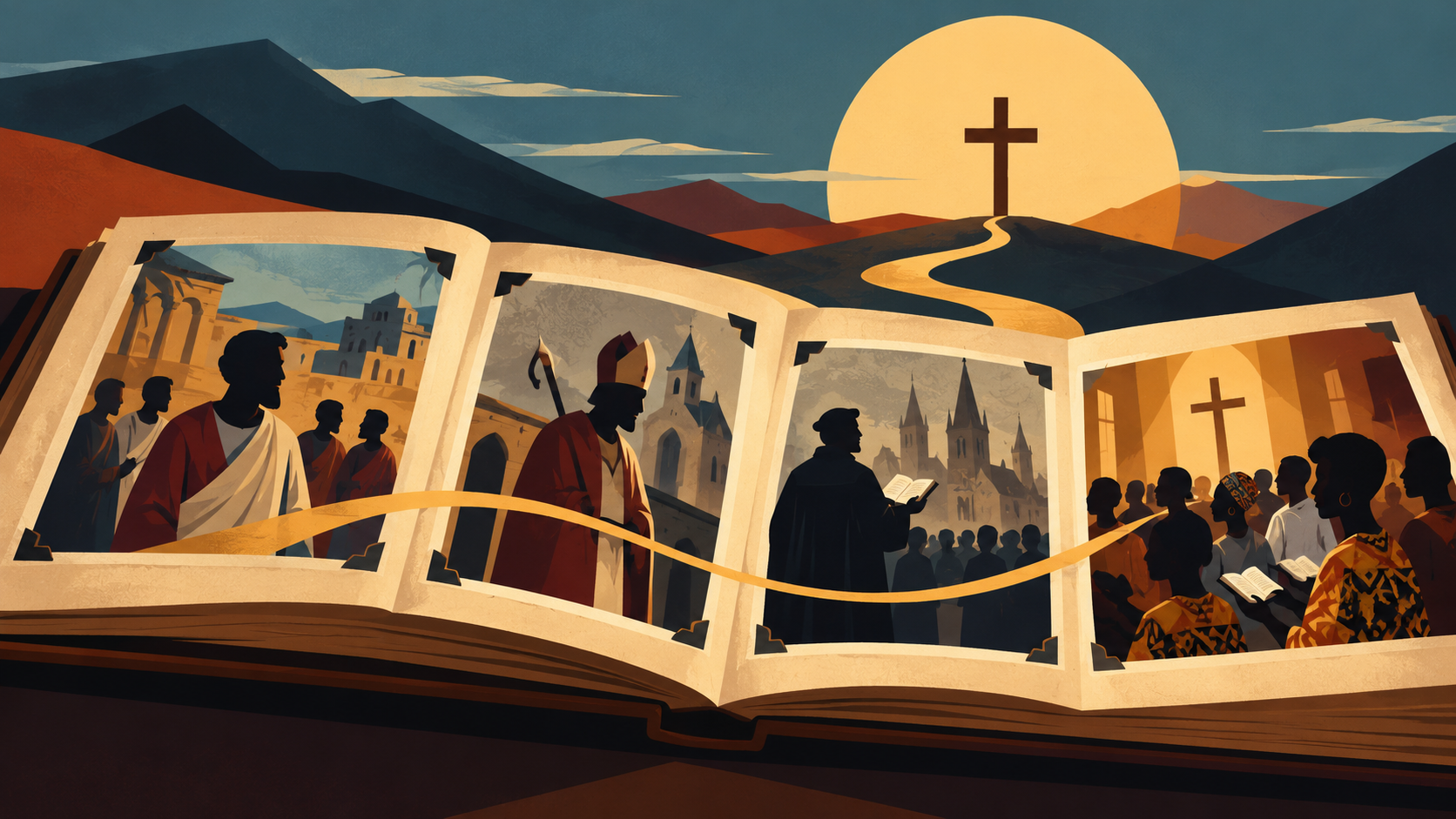
My childhood home was full of treasures. I would often rummage through old boxes, dusty containers, and collections of magazines, hoping to discover something interesting. One day, I came across a container that seemed particularly precious. Inside were photographs. Lots of them.
There were pictures of people I had never seen before. Occasionally, I would recognize a younger version of my father or encounter the unfamiliar face of some grizzled stranger. To my surprise, I even made an appearance in a few of them. As I examined these photographs, something became increasingly clear: I was looking at my family's history.
Some faces were familiar, while others belonged to people whose names and stories I did not know. Yet they were all connected to me. These were people who had lived, loved, struggled, and made decisions long before I came into the world. Although I had never met many of them, their lives formed part of the story into which I was born. I wonder whether you have ever considered that becoming a Christian gives you an extraordinary family history of your own.
The moment you came to faith in Jesus Christ, you were adopted into God's household (Romans 8:15; Ephesians 2:19). You became part of a spiritual family that spans nations, cultures, languages, and centuries. You have brothers and sisters in Christ who lived under the Roman Empire, endured persecution, defended the gospel against false teaching, and faithfully proclaimed the Scriptures long before your grandparents were born.
For nearly two thousand years, Christians have confessed the same Lord, treasured the same gospel, and eagerly anticipated the return of Jesus Christ. We are not the first generation to follow Jesus, nor will we be the last if the Lord delays His coming. We belong to a much larger story. And it is a story worth discovering.
Putting The Pieces Together
One of the unfortunate assumptions found in certain Christian circles is that the Church somehow disappeared shortly after the death of the apostles, only to be rediscovered centuries later. Various restorationist movements have advanced versions of this idea, claiming that authentic Christianity was lost and needed to be restored through a new prophet, revelation, or religious movement. Yet this raises an important question: What happened to Christ's promise to build His Church?
In , Jesus declared that He would build His Church and that the gates of Hades would not prevail against it. Did Christ abandon His building project for hundreds of years? Did the gospel disappear until some modern preacher or movement finally recovered it? Certainly not.
This does not mean that every period of church history was characterised by doctrinal purity or faithfulness. Far from it. Church history contains grievous examples of corruption, compromise, persecution, and theological error. Yet alongside these failures, we discover the remarkable testimony of God's faithfulness in preserving His people and His Word. The history of the Church is therefore not merely a record of human achievements and failures. It is also the unfolding testimony of Christ's continued work among His people.
To appreciate this history, it helps to understand its broad contours. Although the boundaries overlap and historical developments cannot always be neatly categorized, church history is commonly divided into four major periods:
The Early Church (first–fifth centuries): The spread of Christianity, persecution under the Roman Empire, the early church fathers, and the great doctrinal controversies concerning the Trinity and the person of Christ.
The Medieval Church (fifth–fifteenth centuries): The expansion of Christianity across Europe and beyond, the development of church institutions, theological scholarship, and movements calling for reform.
The Reformation and Post-Reformation Era (sixteenth–seventeenth centuries): The recovery and defense of biblical doctrines concerning Scripture, salvation, worship, and the Church, together with the development of Protestant confessions.
The Modern Church (eighteenth century–present): Global missionary expansion, evangelical awakenings, the growth of Christianity across the world, and the theological challenges confronting the Church today.
These periods provide a useful map for understanding how the gospel has been proclaimed, defended, misunderstood, and recovered across different generations. And as we examine this history, we begin to discover that many of the theological questions confronting us today are not nearly as new as we imagine.
New and Old Treasures
Fellow saint, it is necessary to know that you and your local church are not the first generation to crack open the Bible. This fact should produce a profound humility in our hearts as we approach the faith once for all delivered to the saints (). The study of church history also reveals blind spots that we might have in our own day. By reflecting on the Christians of the past, we are served with a good dose of theological antibodies against heresy and bad teaching.
This is important because increasingly the need to come up with something new and novel has become fashionable within certain Christian circles. We must always understand that Christianity has been with us for thousands of years. Our Christian forefathers have been looking into exact same things we speak of in our day. Therefore, when we hear anything that claims to be new, we must verify it against the Bible first and foremost and also check if this has been the position of Bible-believing Christians throughout the ages.
One of my favorite meals is Cape hake and chips, the only thing is, one must be careful to remove the fish bones first. You don’t want them stuck in your throat. Sometimes studying church history can be like that: it’s an amazing dish, just be attentive. Remember, all teaching must be held captive to Scripture (). With that said, by familiarizing yourself with church history you are opening up a real treasure that the Lord has given us. Like a master of a house, who brings out of his treasure what is new and what is old ().
Our African Heritage
Northern Africa is home to some of the greatest early Christian leaders. Allow me to introduce you to a handful of notable characters:
Tertullian (AD 160 – 225), the first great Christian writer in the Latin language was a native of Carthage, in modern day Tunisia. He provided the church with deep reflections on the relationship between Christianity and the Roman Empire, proper moral behavior of Christians, and most notably he was the first Christian writer to use the word “Trinity”. In reflecting on the incarnation, he wrote,
“But we see in Christ two forms of being, not confused with each other, but joined together in one person, Jesus, who is both God and man. And the proper nature of each substance keeps its own full reality.”
Cyprian of Carthage (200 – 258), born into a wealthy family and upon conversion, gave his entire fortune away to the poor. Cyprian had a total commitment to the unity of the church and the importance of church membership. He said, “Whoever stands apart from the church and is joined to an adulteress is cut off from the promises given to Christ’s Church. ”When facing his execution for leading people away from paganism to faith in Jesus, he cried, “Thanks be to God!”
Athanasius of Alexandria (296-373), serving as a deacon at the time of the Council of Nicaea, he distinguished himself as a firm defender of the deity of Christ. He would go on to become a key figure in Christian thought. He stood ‘contra mundum’, i.e., ‘against the world’, as many were following the Arian heresy. Athanasius is an example of not going along with popular opinion ().
Augustine of Hippo (354 – 430), considered to be the greatest theologian to arise since the apostle Paul. A powerful and bright mind, positioned in just the right time in history to counter the Pelagian heresy. Augustine penned several great Christian works: Confessions, On the Trinity, and City of God. These works have been influential throughout the ages. In his commentary on , Augustine writes, “You did not choose Me,” Christ says, “but I chose you”.
Open the Family Album
These four men represent only a small portion of the remarkable history of Christianity in Africa.
There are countless others whose names deserve our attention. Some defended the gospel against heresy. Others suffered persecution, shepherded congregations, translated the Scriptures, or faithfully proclaimed Christ in difficult circumstances.
Many are remembered in historical records. Countless others remain unknown to us. Yet the greatest encouragement is not that these men were extraordinary. It is that the same Lord who sustained His people through those centuries continues to build His Church today.
The God who strengthened Cyprian before his execution, preserved Athanasius through exile, and taught Augustine to marvel at sovereign grace is the same God who calls us to faithfulness in our own generation. Their lives also challenge us.
Are we willing to defend biblical truth when it is unpopular? Do we love the local church as Christ commands? Are we humble enough to learn from Christians who lived centuries before us? Do we appreciate the great theological inheritance that has been handed down to us? Above all, are we committed to preserving and proclaiming the gospel entrusted to the Church?
reminds us of the faithful who went before us, and calls us to run our own race with endurance, looking to Jesus, the founder and perfecter of our faith. The testimony of past generations should encourage us to do the same.
Church history is not merely a collection of interesting dates, forgotten controversies, and remarkable personalities. It is an invitation to recognize the faithfulness of Christ, learn from the victories and failures of those who preceded us, and take our own place in the continuing story of His Church.
We have inherited a faith to cherish, a truth to defend, and a gospel to proclaim. So, fellow Christian, open the family album. Discover the brothers and sisters who have gone before you. Learn from their courage, recognize their failures, examine their teaching, and give thanks for the grace of God displayed throughout their lives.
And as you turn its pages, remember that the greatest figure in the history of the Church is not Tertullian, Cyprian, Athanasius, Augustine, Luther, or Calvin. It is Jesus Christ.
He is the One who promised to build His Church. He is the One who has preserved His people throughout the centuries. And He is the One who will bring His people safely home. The family album ultimately tells the story of His faithfulness.