
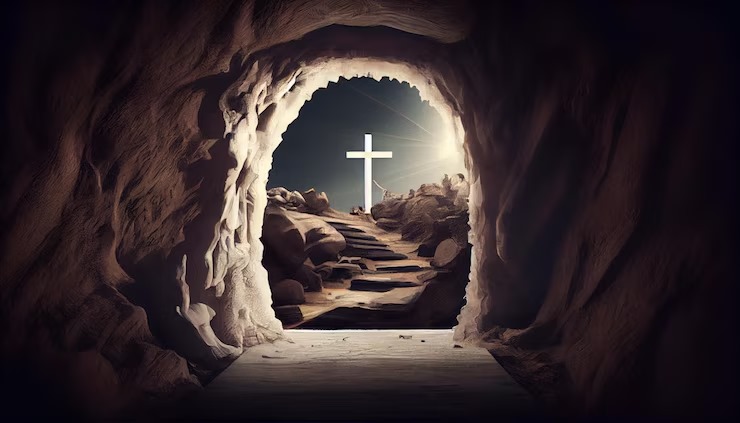
Throughout the annals of time, no week holds greater redemptive significance than the week of our Lord’s Passion and Resurrection. Its gravity is rivalled only by the week of Creation. In the first, God brought the world into being; in the second, Christ accomplished the redemption through which all things will finally be made new.
The Gospel writers do not assign every event to a particular day, and some details of the chronology remain debated. Nevertheless, the following provides a helpful overview of the events that unfolded during this most momentous week.
Palm Sunday
The week begins with Jesus entering Jerusalem amid cries of “Hosanna!” The crowds spread their garments and palm branches before Him, welcoming Him as the long-awaited Son of David.
Riding upon a donkey, Jesus deliberately fulfils the prophecy of Zechariah:
“Behold, your king is coming to you; righteous and having salvation is he, humble and mounted on a donkey.”
The city is stirred by His arrival. Yet the crowds do not fully understand the kind of King He is or the salvation He has come to accomplish. They expect victory, but not through suffering; a kingdom, but not through the cross.
Jesus enters Jerusalem as its rightful King. Yet before He wears the crown of glory, He will wear a crown of thorns.
Scriptural references: ; ; ; .
Monday to Wednesday
As the excitement of the triumphal entry subsides, Jesus confronts the spiritual corruption of Jerusalem.
He enters the Temple and drives out those who are buying and selling, declaring:
“My house shall be called a house of prayer, but you make it a den of robbers.”
This is more than a protest against dishonest trade. Israel’s King has entered His Father’s house and found it polluted. His actions serve as a prophetic sign of approaching judgment.
Jesus also curses a barren fig tree. Though covered with leaves, it bears no fruit—a fitting picture of outward religion without genuine faith and obedience.
During these days, the religious authorities repeatedly question Jesus, attempting to trap Him in His words. Instead, their challenges expose their own unbelief. Jesus teaches through parables, pronounces woes against hypocrisy, foretells the destruction of the Temple, and speaks of His future return as the Son of Man.
Meanwhile, Judas Iscariot agrees to betray Him for thirty pieces of silver.
The King continues teaching publicly while, in secret, His enemies prepare His death.
Scriptural references: :46; :37; :38; .
Thursday
On Thursday evening, Jesus turns His attention more directly towards His disciples. He gathers with them to share the Passover meal—the meal commemorating Israel’s deliverance from slavery in Egypt.
Yet now the true Passover Lamb sits among them.
During the meal, Jesus washes His disciples’ feet, demonstrating the humble and self-giving love that is to characterise His people. He identifies Judas as His betrayer, foretells Peter’s denial, and comforts His disciples with the promise of the Holy Spirit.
He also institutes the Lord’s Supper. Taking bread, He says:
“This is my body, which is given for you.”
Taking the cup, He declares:
“This cup that is poured out for you is the new covenant in my blood.”
The bread and cup point towards the sacrifice He is about to make and provide the church with an enduring proclamation of His death until He returns.
Later, in the Garden of Gethsemane, Jesus prays in great anguish:
“Father, if you are willing, remove this cup from me. Nevertheless, not my will, but yours, be done.”
The cup before Him is not merely physical suffering. It is the cup of divine judgment against sin. Yet the Son submits Himself perfectly to the will of the Father.
Judas soon arrives with an armed crowd and betrays Jesus with a kiss. Peter reaches for his sword, but Jesus will not be rescued. He has come for this very hour.
Scriptural references: ; ; ; :11.
Good Friday
Following His arrest, Jesus is subjected to a series of Jewish and Roman hearings. He appears before Annas, Caiaphas, the Sanhedrin, Pontius Pilate, and Herod Antipas before being returned to Pilate for final judgment.
False witnesses accuse Him. The religious authorities condemn Him for blasphemy. Pilate finds no guilt deserving death, yet yields to the demands of the crowd.
The soldiers clothe Jesus in a robe, press a crown of thorns upon His head, and mock Him as “King of the Jews.” Their cruelty unintentionally announces the truth: the condemned man before them is indeed the King.
Jesus is led to Golgotha and crucified between two criminals. For approximately six hours He hangs upon the cross.
There the sinless Son of God bears the sins of His people:
“He was pierced for our transgressions; he was crushed for our iniquities.”
At noon, darkness covers the land. Jesus cries:
“My God, my God, why have you forsaken me?”
The Suffering Servant endures the judgment sinners deserve. The Shepherd is struck so that His wandering sheep may be brought home.
At last, Jesus declares:
“It is finished.”
His redemptive work is accomplished. The price has been paid. The curtain of the Temple is torn from top to bottom, signifying that through His blood the way into God’s presence has been opened.
Jesus commits His spirit into His Father’s hands and dies.
Joseph of Arimathea, assisted by Nicodemus, places His body in a new tomb. The Author of Life lies dead within the earth.
Scriptural references: :66; :47; :56; :42.
Holy Saturday
The noise of arrest, accusation, mockery, and crucifixion gives way to silence.
Jesus’ body remains in the tomb. His disciples are scattered, grieving, and afraid. From their perspective, the hope of Israel has been buried behind a sealed stone.
Yet the silence of Saturday is not the silence of defeat. Christ’s atoning work has been completed. Nothing remains to be added to His sacrifice.
As God rested after completing the work of Creation, so the Son rests in the grave after declaring the work of redemption finished.
A created stone seals the tomb of the Rock of Ages—but it cannot hold Him.
Scriptural references: ; ; ; .
Easter Sunday
Before sunrise on the first day of the week, several women go to the tomb. Instead of finding the body of Jesus, they discover the stone rolled away.
An angel announces:
“He is not here, for he has risen, as he said.”
Jesus has not merely survived death, nor has He returned as a disembodied spirit. He has been raised bodily and gloriously, never to die again.
The risen Christ appears to Mary Magdalene and then to His other disciples. He speaks with them, shows them His wounds, walks with them, and eats in their presence. The same Jesus who was crucified is alive.
His Resurrection vindicates His identity and confirms the sufficiency of His sacrifice. Sin’s penalty has been paid, death’s dominion has been broken, and the new creation has begun.
As the apostle Paul writes:
“If Christ has not been raised, your faith is futile and you are still in your sins.”
But Christ has been raised. He is the firstfruits of those who have fallen asleep. His Resurrection guarantees the resurrection of all who are united to Him by faith.
The question Jesus asked Martha therefore confronts every one of us:
“I am the resurrection and the life. Whoever believes in me, though he die, yet shall he live.… Do you believe this?”
The King who entered Jerusalem has conquered.
The Lamb who was slain is alive.
The tomb is empty.
Death has been defeated.
Scriptural references: ; ; ; :25.