
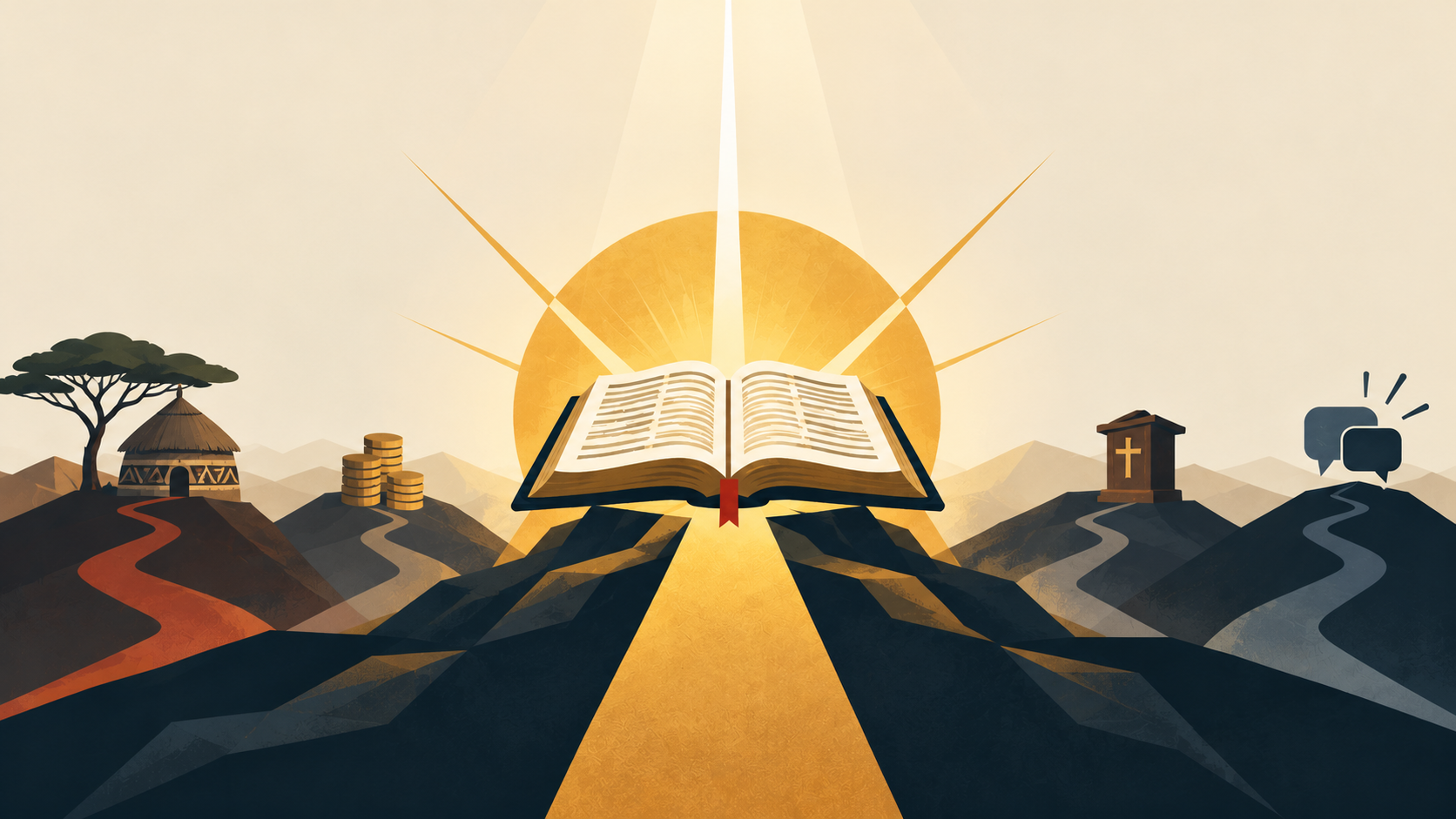
A World of Many Voices
A church leader declares, “God told me,” and expects his words to be accepted without question. A respected relative insists, “This is how our family has always done things.” A popular preacher promises divine blessing in exchange for a financial offering. Elsewhere, the voices of politics, social media, and popular culture demand that Christians reconsider what they have always believed.
These claims are not all alike, nor do they deserve the same response. Yet each presses upon our beliefs, loyalties, and decisions. Across Africa’s diverse churches and communities, as elsewhere in the world, Christians encounter voices offering wisdom, direction, and sometimes claims of divine authority. Some deserve our attention and respect. Others must be rejected. None may occupy the place that belongs to God alone.
Which voice has the right to govern the Christian life and bind the Christian conscience before God? And who has the final word in the church?
The Christian answer begins with a glorious truth: God has spoken.
The Bible Is God’s Address to Man
“All Scripture is breathed out by God.” —
The Bible, the sixty-six books of the Old and New Testaments, is not merely a record of humanity’s religious search for God. It is God’s address to humanity. Its authority rests upon its ultimate Author. By authority, we mean Scripture’s right to govern what we must believe, what we must reject, and how we must live before God.
This is the God who spoke creation into being and made us in His image. He spoke to Adam, Noah, Abraham, Moses, and the prophets. He spoke through the apostles of the New Covenant. Above all, He has spoken climactically in His beloved Son, Jesus Christ ().
When we open Scripture, therefore, we are not merely reading ancient religious literature, moral advice, or human reflections about God. We are hearing the written Word of the living God, breathed out by His Spirit and given with divine authority.
Paul goes on to explain that Scripture is profitable for teaching, correction, and training in righteousness, so that the servant of God may be “complete, equipped for every good work” (). God has given His church a sufficient rule for faith and godliness. We do not need another infallible message to complete what He has spoken.
The church does not grant the Bible its authority. Neither does a pastor, council, theological institution, or cultural tradition. All may study, teach, confess, and obey Scripture, but none stands above it. Scripture is authoritative because God has spoken.
The Human Authors and the Divine Author
In his second letter, the apostle Peter recalls the Transfiguration. He saw Christ’s majesty and heard the Father’s voice from heaven (). This was no rumour or secondhand report. Yet Peter does not set his extraordinary experience against the Scriptures. Rather, the glory he witnessed confirmed the prophetic Word that had already announced the coming of Christ. He directs believers to that Word as a lamp shining in a dark place ().
Peter then explains its origin: “No prophecy was ever produced by the will of man, but men spoke from God as they were carried along by the Holy Spirit” (). Scripture did not arise from human imagination, private intuition, or religious genius. Its source is God Himself.
This does not mean the biblical writers were mindless instruments. They wrote in real historical settings, employing their own languages, vocabularies, personalities, and literary forms. The histories, poetry, laws, prophecies, Gospels, and letters of Scripture bear the marks of genuine human authorship. Yet God worked through these authors so that what they wrote is truly His Word.
That is why Scripture’s authority comes from above, not from below. The church receives and recognises the Word of God; it does not make a writing into God’s Word by its approval. The early church treasured other Christian writings, but even valuable and ancient writings were not thereby Scripture. The prophetic and apostolic writings possess an authority that no later Christian work can claim.
Paul thanked God that the Thessalonians received the apostolic message “not as the word of men but as what it really is, the word of God” (). The proper response to God’s Word is not to place ourselves over it as judges, but to receive it with faith and obedience.
Christ’s Own View of Scripture
“Scripture cannot be broken.” —
Our Lord Jesus shows us how to regard the Scriptures. Before the New Testament was completed, the term Scripture referred chiefly to the sacred writings of the Old Testament—the Law, the Prophets, and the Writings. Jesus received them as truthful, binding, and authoritative.
He resisted Satan by Scripture (), corrected error by Scripture (), and submitted to Scripture in the events leading to His death (). He declared that Scripture cannot be broken (), and He opened the Scriptures to show that they testify to Him (; ).
Jesus did more than honour the Old Testament. He commissioned His apostles as authorised witnesses and promised that the Holy Spirit would bring His teaching to their remembrance and guide them into the truth (). Christ Himself therefore stands behind the apostolic testimony on which the New Testament rests, whether written by the apostles or by those closely associated with their witness.
This authority is especially clear in Paul’s ministry. Paul wrote not simply as a thoughtful religious teacher, but as an apostle commissioned by the risen Christ. Peter even speaks of Paul’s letters alongside “the other Scriptures” (). Already in the apostolic age, these letters were being treated as Scripture, not merely as helpful reflections.
Jesus is thus both the fulfilment and the centre of Scripture, and the Lord who authorised the apostolic witness. If we claim to follow Christ, we cannot disregard the Word that He honoured, fulfilled, and entrusted to His church. To submit to Scripture is to submit to the authority of Christ.
Scripture Above Every Lesser Authority
“See to it that no one takes you captive by philosophy and empty deceit, according to human tradition … and not according to Christ.” —
At the heart of the Protestant Reformation stood a question that every generation must answer: Who has the final word in the church? The Reformers insisted that neither ecclesiastical office, inherited tradition, nor human decree could stand alongside the written Word of God as an equally infallible rule. The church must continually be corrected and reformed by Scripture because it belongs to Christ.
This is the principle of sola Scriptura: Scripture alone is the church’s final, infallible rule for faith and life. It does not mean that pastors are unnecessary, creeds are worthless, or Christians must interpret the Bible in isolation. It means that every lesser authority is accountable to God’s Word.
Pastoral authority is real, but it is not ultimate. Christ gives His church shepherds who must teach, lead, and care for His people (; ). Faithful preaching therefore deserves serious attention and obedience to the truth it communicates. Yet a pastor’s authority is ministerial, not independent: he is a servant of the Word, not its master. No pastor, bishop, or person claiming the title of apostle or prophet can turn a personal opinion into God’s command simply by invoking an office. Even the Bereans were commended for examining Paul’s preaching against the Scriptures ().
Private claims to divine guidance cannot bind the conscience. Christians rightly seek God’s guidance through prayer, providence, and wisdom shaped by His Word. But no dream, vision, impression, or declaration that “God told me” can establish doctrine or bind another believer’s conscience with Scripture’s authority. We must not confuse the confidence of a speaker with the voice of God. A leader who demands unquestioning obedience to a supposed revelation claims an authority God has not given him.
Cultural traditions must also be judged by Scripture. Honor for parents and elders, communal responsibility, hospitality, and respect for inherited wisdom can be genuine goods. But no custom becomes right simply because it is old, widespread, or associated with our people. Where expectations concerning spiritual protection, ancestral mediation, marriage, or family obligations conflict with God’s Word, the Christian must follow Christ. Scripture teaches us to honour our families without making family tradition our final authority. There is one mediator between God and man, Jesus Christ ().
Nor is this a problem unique to Africa. Western individualism, secular assumptions, consumerism, and political ideologies must come under the same judgment. Scripture is neither a Western possession nor a tool for defending whatever is called authentically African. It is God’s Word to all peoples. Every culture has gifts that can be received with gratitude and sins that must be confronted with repentance.
Promises of prosperity must answer to the gospel. When a preacher treats financial offerings as a guaranteed route to health, wealth, or spiritual breakthrough, he must be measured against the teaching of Christ and His apostles. Scripture calls Christians to generosity, but it never makes God a debtor to those who give. The gospel announces the crucified and risen Christ, not an assurance of earthly comfort ( ).
Science, psychology, and philosophy can also offer genuine insight into God’s world and human life. We need not fear careful inquiry. Yet none may overturn what God has revealed concerning sin, salvation, holiness, or our final hope. Likewise, superstition, horoscopes, and appeals to hidden spiritual powers must not be allowed to direct the lives of those who belong to Jesus Christ.
In every case, the question is the same: Has God spoken on this matter, and are we prepared to hear Him? Scripture does not answer every imaginable question, but wherever it speaks, it is decisive. A church remains faithful not through compelling personalities or deeply rooted customs, but by listening to the Word of its Lord.
The Glad Submission of God’s People
“His commandments are not burdensome.” —
The authority of Scripture is not an abstract doctrine reserved for theological debates. It shapes our worship, preaching, discipleship, marriages, parenting, work, speech, generosity, and witness. It protects the church from being ruled by personality, preference, fear, or pragmatism. And it directs us again and again to Jesus Christ.
Across nations, languages, and generations, the people of God are gathered into one body. Scripture does not belong to one culture or denomination. It is the voice of the one Shepherd who calls His sheep and teaches them to follow Him (). The same Word that corrects us also comforts us; the God who commands us is the God who saves and sanctifies His people.
Our submission, therefore, is not reluctant or miserable. It is the glad submission of sheep who know their Shepherd’s voice. We do not honour the Bible in place of Christ. We honour the Bible because it is God’s Word, bears witness to Christ, and teaches us to know, trust, and obey Him.
The church does not stand above the Word of God. The church stands under it.
In a world of many voices, the church need not be carried along by every trend, tradition, claimed revelation, or fear. God has spoken. His Word is true. His Son is sufficient. His Spirit gives understanding. Let His people hear, believe, obey, and rejoice.